My repeatable protein method

How to eat 100g of protein a day without tracking every meal.

I repeat a breakfast and lunch whose protein I already know, then eat the same dinner I make for my children. It removes food decisions without asking me to track every bite.

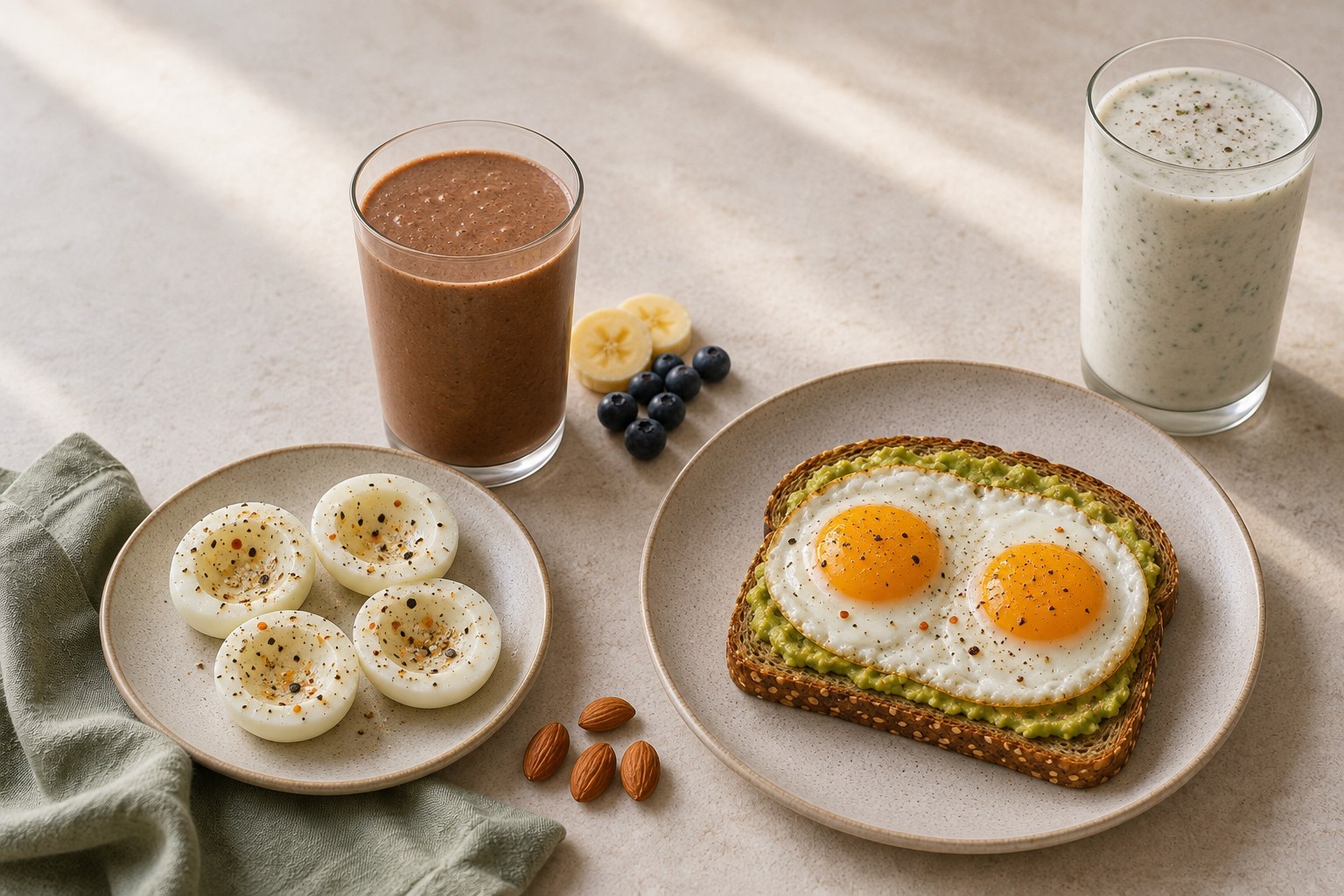
Illustrated meal setup with seasoned boiled egg whites, a chocolate smoothie, one avocado toast with two fried eggs, four almonds and Greek-yogurt chaas
Illustrated meal example≈ 75–80g

The short answer

Calculate two meals once. Reuse the answer.

My repeatable breakfast and lunch provide roughly 75–80g using my usual products and portions. Dinner usually supplies the rest. If dinner is lower in protein, I add a familiar snack such as edamame.

≈ 75–80grepeatable breakfast + lunch+ ≈ 20–25gfamily dinner and/or snack= ≈ 100gpersonal example

My repeatable breakfast

Seasoned egg whites + chocolate protein smoothie

≈ 39–40g≈ 350 calories

What I use

  • 4 boiled egg whites, topped with salt, black pepper, red pepper flakes and everything-bagel seasoning
  • 1 serving (2 scoops) Orgain Chocolate Fudge protein powder
  • ¼ cup whole milk and ¾ cup water
  • ¼ banana and a handful of frozen blueberries
  • 4 almonds

I have repeated this breakfast for months because I genuinely enjoy it. Repetition works better when the default tastes good—not when it feels like punishment.

IngredientProteinCalories
4 large egg whites≈ 14g≈ 68
Orgain Chocolate Fudge, 1 serving21g150
Whole milk, ¼ cup≈ 2g≈ 38
¼ banana + frozen blueberries≈ 1g≈ 65–75
4 almonds≈ 1g≈ 28
Breakfast estimate≈ 39–40g≈ 349–359

My repeatable lunch

Fried-egg avocado toast + Greek-yogurt chaas

≈ 36–40g≈ 430–530 calories*
IngredientProteinCalories
2 large eggs≈ 12g≈ 140
Dave’s Killer Bread, 1 slice≈ 5–6g110
Avocado, ¼–½ medium≈ 1–2g≈ 80–160
Kirkland plain Greek yogurt, 1 label serving≈ 18–20g≈ 100–120
Water, salt, mint + pepper0g≈ 0
Lunch estimate≈ 36–40g≈ 430–530*

Make the toast

Fry two eggs and top them with salt and red pepper flakes. Toast one 110-calorie slice of Dave’s Killer Bread, spread with ¼–½ avocado, and add the eggs.

Make the chaas

Thin one label serving of Kirkland plain Greek yogurt with cold water. Season it with salt, mint powder, black pepper and any spices you enjoy.

*Cooking oil or butter is not included because the amount used varies. It adds calories but essentially no protein. Your yogurt and bread labels take priority over these estimates.

Breakfast + lunch using these products≈ 75–80g protein · roughly 780–890 calories plus cooking fat

A little choice, not more tracking

Pick one breakfast and one lunch for the week.

These are swaps, not extra food. Choose a pair, check your product labels once and repeat it on busy days.

Breakfast

Priyanka’s default

Egg whites + protein smoothie

≈ 39–40g · ≈ 350 cal

About 5 min with eggs prepared
Egg-free

Chocolate overnight protein oats

≈ 44g · ≈ 480 cal + fruit

5 min the night before
Egg-free

Chocolate-PB Greek-yogurt bowl

≈ 44g · ≈ 350 cal

About 5 min · no blender

Lunch

Priyanka’s default

Egg-avocado toast + chaas

≈ 36–40g · ≈ 430–530 cal*

About 10 min
Egg-free

Crispy tofu-edamame rice bowl

≈ 39g · ≈ 530 cal

About 5 min when batch-prepped
Egg-free

Spiced lentil-quinoa bowl + raita

≈ 42g · ≈ 480 cal

About 5 min when batch-prepped

Dinner comes from the family pot

I eat what I make for my children.

I do not want a separate “diet dinner.” After my repeatable breakfast and lunch, a protein-containing family meal may close the gap; a simple snack can help when dinner is lighter.

Usually closes the gap

Dal, chole or rajma with rice

Often ≈ 18–25g

A substantial serving of lentils or beans plus rice usually clears the remaining gap comfortably.

Check the main ingredient

Two roti + sabzi

Often ≈ 8–18g

Paneer, soy, peas or bean-based sabzi can be higher. A mostly vegetable sabzi may need dal, Greek yogurt or another protein side.

Easy to strengthen

Pasta with vegetables

Often ≈ 10–18g

The pasta portion and brand matter. Beans, peas, cheese, tofu, lentil pasta or chickpea pasta can turn it into a more reliable 20g dinner.

Dinner values are broad estimates because family recipes and serving sizes vary significantly. Check each common family dinner once; you do not need to log it every night.

40g

My going-out rule

Get breakfast in, then go enjoy the day.

On restaurant, travel or family-outing days, I eat my approximately 40g breakfast before leaving. I may not get the full breakfast-and-lunch total, but I have already removed one decision and given the day a strong start. One flexible day does not cancel a repeatable routine.

The no-daily-tracking workflow

Do the thinking once. Test one repeatable week.

Use your labels once, save the estimates, and measure whether the routine required less attention—not whether seven days were perfect.

  1. 01

    Choose defaults

    Pick one breakfast and one lunch you genuinely like enough to repeat.

  2. 02

    Calculate once

    Use the products and portions in your kitchen. Save the approximate totals.

  3. 03

    Plan for flexibility

    List familiar family dinners and one optional snack for lower-protein days.

  4. 04

    Repeat and review

    Try the routine for seven days, then keep, rotate or replace what did not work.

Free printable

Take the experiment into your week.

Write down your defaults, check off the routine, and notice whether it reduced decision-making.

Download the 7-day checklist

Common questions

Keep the structure. Leave room for life.

Can I get 100g of protein without tracking macros every day?

You can reduce daily tracking by calculating repeatable meals once and keeping a small set of known dinner patterns. This is less precise than logging every ingredient, but it can provide useful structure without requiring constant data entry.

Does everyone need 100g of protein?

No. One hundred grams is my personal example, not a universal recommendation. Needs differ with body size, age, activity, goals, pregnancy or breastfeeding status and health.

What if my dinner is low in protein?

Nothing has failed. You can accept a lower day or add a familiar snack or side such as edamame, Greek yogurt, dal, beans, paneer or tofu. The point is consistency over time, not forcing every day to equal exactly 100.

Do I have to eat the same meals forever?

No. Repeat for a week, rotate between two known options, or replace a meal when you are ready. Calculate the new option once and it becomes another usable default.

Can I use an egg-free version?

Yes. The high-protein vegetarian meal plan includes egg-free breakfasts and lunches with calculated examples.